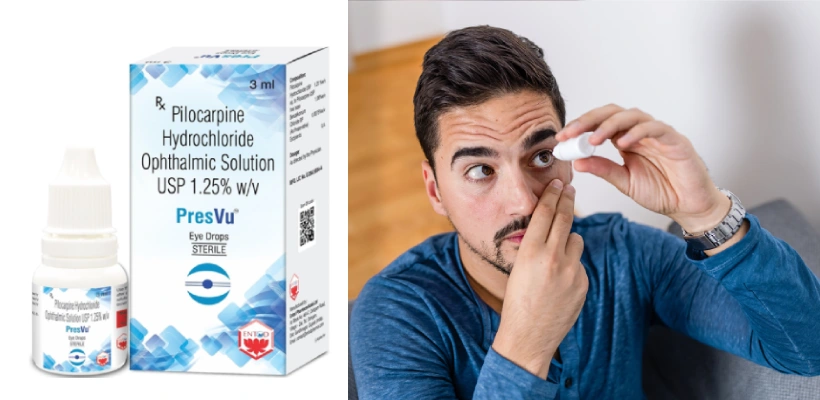
Presbyopia affects nearly everyone after the age of 40. As near vision blurs, reading glasses become part of daily life. In recent years, PresVu eye drops entered the market promising a dramatic alternative—clear near vision without spectacles.
The claim attracted attention. It also raised concern.Medical experts, regulatory authorities, and recent investigations have clarified that PresVu eye drops do not replace reading glasses. Understanding the reality behind the marketing is essential before making decisions that affect your eyesight.
Medical & Regulatory Disclaimer
This blog is published strictly for patient awareness and education. It does not endorse PresVu eye drops as a replacement for reading glasses. Recent regulatory scrutiny and expert evaluations confirm that PresVu provides temporary visual effects only and does not correct or cure presbyopia. Any medication affecting vision must be used only under the supervision of a qualified eye specialist.
What Exactly Are PresVu Eye Drops?
PresVu eye drops are pharmacological drops marketed for people with presbyopia, an age-related condition where the eye loses its ability to focus on nearby objects.
Presbyopia occurs because:
- The natural lens becomes rigid with age
- The eye cannot adjust focus for near tasks
- This change is permanent and progressive
PresVu does not reverse this process. It does not restore accommodation. It only creates a short-lived optical effect.
The Marketing Gimmick: “No Glasses, No Worries”
PresVu was promoted with slogans strongly implying freedom from reading glasses.
This messaging led many users to believe it was a permanent solution.
However, expert medical reviews and regulatory bodies clarified that:
- The effect is temporary
- The drops do not correct presbyopia
- Glasses remain necessary for consistent vision
The Drugs Controller General of India (DCGI) directed state authorities to take action against misleading promotional claims. Medical publications openly stated that spectacles are still the safest and most effective correction.
Marketing convenience does not equal medical accuracy.
How PresVu Eye Drops Work
PresVu eye drops work by creating a temporary pinhole effect.
This effect:
- Slightly constricts the pupil
- Increases depth of focus
- Gives short-term improvement in near vision
This mechanism:
- Does not treat the underlying cause
- Lasts only a few hours
- Varies between individuals
Once the effect fades, near vision returns to baseline.
Uses
PresVu eye drops may be considered:
- For occasional near tasks
- In early prebyopia
- Under strict medical advice
- As a temporary aid only
They are not meant for daily dependence or long-term use.
Benefits
Limited benefits reported include:
- Short-term near vision clarity
- Temporary convenience
- No need for spectacles during the effect window
These benefits are inconsistent and unpredictable when compared to reading glasses.
The Reality: Temporary Relief, Not a Permanent Fix
Presbyopia is caused by structural aging of the eye lens.
No eye drop:
- Reverses lens stiffness
- Restores natural focusing
- Permanently improves near vision
PresVu provides symptom masking, not treatment. Once the effect wears off, vision impairment returns.
Reading glasses:
- Correct vision reliably
- Cause no pharmacological side effects
- Are predictable and safe
- Remain the gold standard
There is no medical evidence supporting eye drops as a substitute for spectacles in presbyopia.
What About the Side Effects?
Before you start celebrating the idea of a glasses-free life, let’s talk about the side effects. Pilocarpine, the active ingredient in PresVu eye drops, isn’t new to the game, having been used in the treatment of glaucoma for years. However, its higher concentrations in glaucoma medications came with some undesirable side effects, which is why its use has declined in favor of newer treatments.
With the 1.25% concentration in PresVu, the side effects may still rear their head. Some of the potential issues include:
– Pupil constriction: This could result in difficulty seeing in low light or affect your distance vision.
– Headaches: Let’s face it, if trying to read without glasses gives you a headache, you won’t be getting too far.
– Irritation and redness: Using eye drops multiple times a day might lead to some discomfort or eye irritation.
– Peripheral vision issues: This can make navigating your surroundings more challenging.
There’s also the potential for more serious long-term side effects. For instance, constant pupil constriction could interfere with procedures like cataract surgery. And in individuals with pre-existing conditions, like myopia, there’s a concern about the risk of retinal detachment. So, it’s crucial to approach these drops with caution.
Is PresVu the Right Solution for You?
PresVu may be discussed only if:
- You understand it is temporary
- You accept glasses are still required
- Your eye specialist approves its limited use
- There are no contraindications
It is not suitable for:
- Advanced presbyopia
- Daily vision correction
- Patients with ocular surface disorders
- Those seeking permanent solutions
Medical decisions should never be driven by convenience claims.
Conclusion: Glasses Might Still Be Your Best Bet
PresVu eye drops do not replace reading glasses.
Regulatory scrutiny and medical consensus confirm that presbyopia requires optical correction, not shortcuts.
Reading glasses remain:
- Safer
- More effective
- Scientifically proven
- Cost-efficient
Eye drops offering temporary relief should not be confused with true treatment.
If you are experiencing difficulty with near vision, the correct step is a comprehensive eye examination, not reliance on marketing claims.
If you suspect presbyopia or want trustworthy guidance, consult an experienced eye specialist in Mumbai.
Dr Seema Behl, one of the best eye specialists in Mumbai and founder of Smart Vision Eye Centre, has over 25 years of experience providing ethical, evidence-based eye care.With a state-of-the-art facility in Andheri, Dr Seema Behl is committed to protecting every patient’s right to clear vision and a productive life.
Book an appointment today at Smart Vision Eye Centre and choose medical clarity over commercial promises.
Frequently Asked Questions About PresVu Eye Drops
Q. What Are PresVu Eye Drops?
Answer: PresVu eye drops, developed by Entod Pharmaceuticals, contain 1.25% pilocarpine to address presbyopia, the age-related loss of near vision flexibility starting around age 40.
Pilocarpine constricts the pupil to reduce visual noise, improves depth of focus, and tightens ciliary muscles for temporary near vision enhancement.
Effects last 4-6 hours, requiring multiple daily applications.
Q. How Do PresVu Drops Work?
Answer: The drops constrict the pupil, minimizing aberrations and boosting near vision by shifting the lens slightly forward.
Users apply them 30 minutes before needing close-up vision, like reading or phone use.
This provides short-term relief but demands planning and frequent reapplication.
Q. Can PresVu Replace Reading Glasses?
Answer: PresVu Eye Drops can temporarily improve near vision for some people with presbyopia. However, the effect is short-lived (4-6 hours) and requires repeated use. While they may reduce the need for reading glasses for a few hours, they are not a permanent replacement and may cause side effects like reduced distance vision.
Q. What Side Effects Should I Expect?
Answer: Common side effects of PresVu Eye Drops include pupil constriction, which can affect distance vision and make it difficult to see in low light. Other potential side effects are headaches, eye irritation, and peripheral vision issues. Long-term use may also interfere with certain eye surgeries.
Q. Is Long-Term Use of PresVu Safe?
Answer: Long-term use of PresVu Eye Drops is not fully established as safe. While short-term use is generally well-tolerated, prolonged use may lead to potential side effects like difficulty seeing in low light, and could affect eye structures over time. It’s important to consult with an eye care professional before using these drops long-term.
Q. Should I Try PresVu Eye Drops?
Answer: If you’re looking for a temporary solution to improve near vision and reduce reliance on reading glasses, PresVu Eye Drops may be worth trying. They work for some people, but the effect is temporary (a few hours) and may require multiple applications. Be aware of potential side effects like blurry vision in low light and headaches. It’s a good option for short-term use, but not a permanent fix.